












AUTOHOISTPRO BLOG - LIFT COMPARISONS
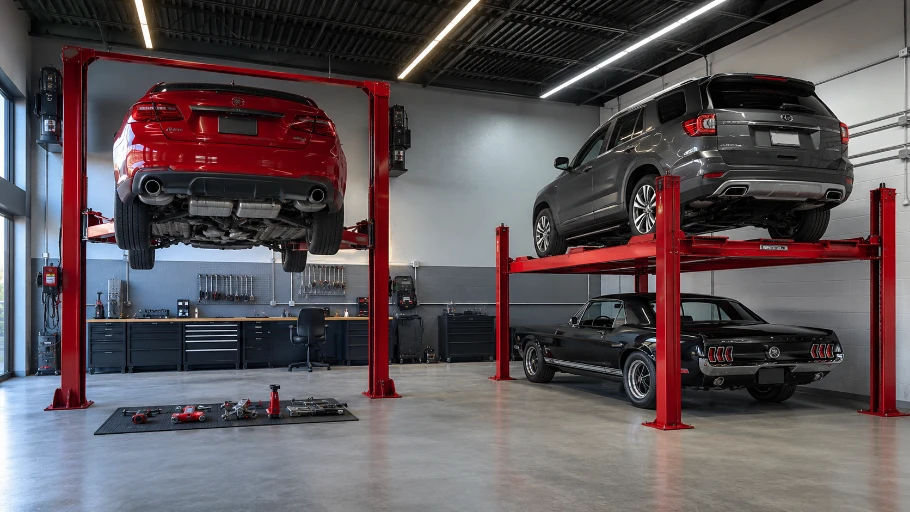
Choosing between a 2-post and a 4-post lift? Here's the truth: 2-post lifts offer better access for repairs, while 4-post lifts excel at storage. Both ship free freight from AutoHoistPro's 3 US hubs. If you're asking which car lift is better for your garage, the honest answer is that it depends almost entirely on what you do under the vehicle – turn wrenches, or park a second car overhead. The 2-post vs 4-post comparison comes down to four things: cost, concrete, ceiling, and how much undercarriage access you genuinely need. In this guide we compare real 2026 pricing, space requirements, installation difficulty, and use cases side by side, so you can confidently choose the best lift for your home garage – and know exactly what you'll pay, including the freight most dealers quietly add at checkout. We'll also cover the accessories that change the math (bridge jacks, rolling casters, truck adapters) and the scenarios where one design wins decisively over the other.
Table of Contents
Quick Comparison Table
At a glance, here's how the two designs stack up on the numbers that decide your build:
| Spec | 2-Post Lift | 4-Post Lift |
|---|---|---|
| Price range (2026) | $2,500-$7,000 | $3,000-$8,000 |
| Floor space required | 12' × 12' minimum | 14' × 16' minimum |
| Ceiling height | 11'-12' | 12'-14' |
| Best for | Repairs & maintenance | Storage & parking |
| Installation | Requires concrete anchoring | Portable, no anchoring |
| Vehicle access | Full undercarriage | Runways block the center |
| Shipping | FREE from AutoHoistPro | FREE from AutoHoistPro |
Both designs include free shipping from AutoHoistPro's distribution centers, which already puts you $300-$800 ahead of dealers who charge for LTL freight. That single line item is often the difference that makes a 2-post the better value – and it's why we lead with it before talking about anything else. Read the table as the floor of what you'll pay, not the ceiling: capacity upgrades, longer arms, taller ceilings, and accessories like bridge jacks all nudge the number up, but freight at AutoHoistPro is always zero. For most buyers the decision really does come down to the last two rows of that table – full undercarriage access versus storage and portability – so let's unpack each design in detail.
What Is a 2-Post Lift?
How It Works
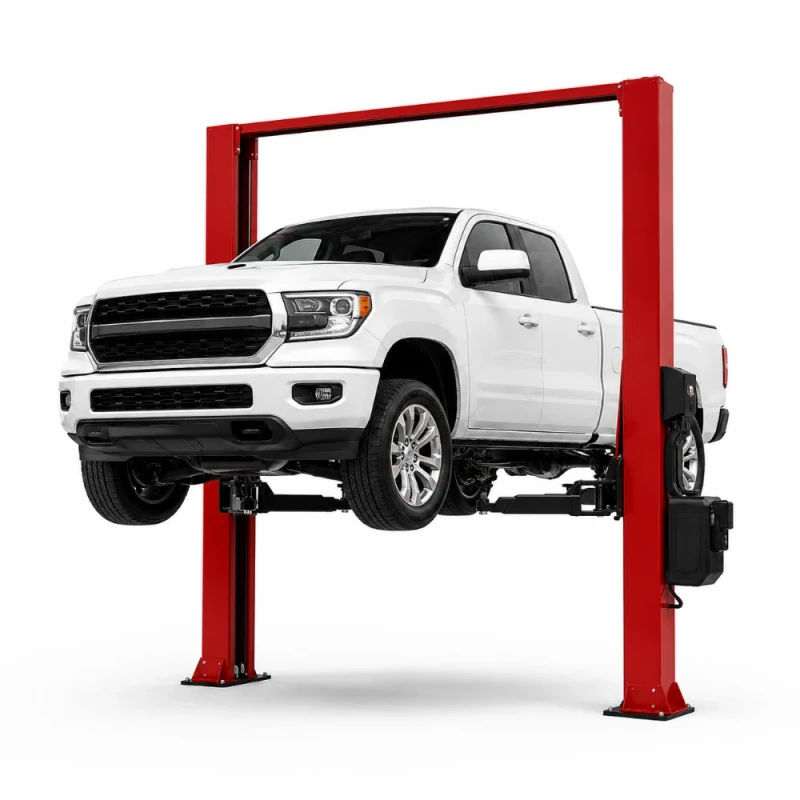
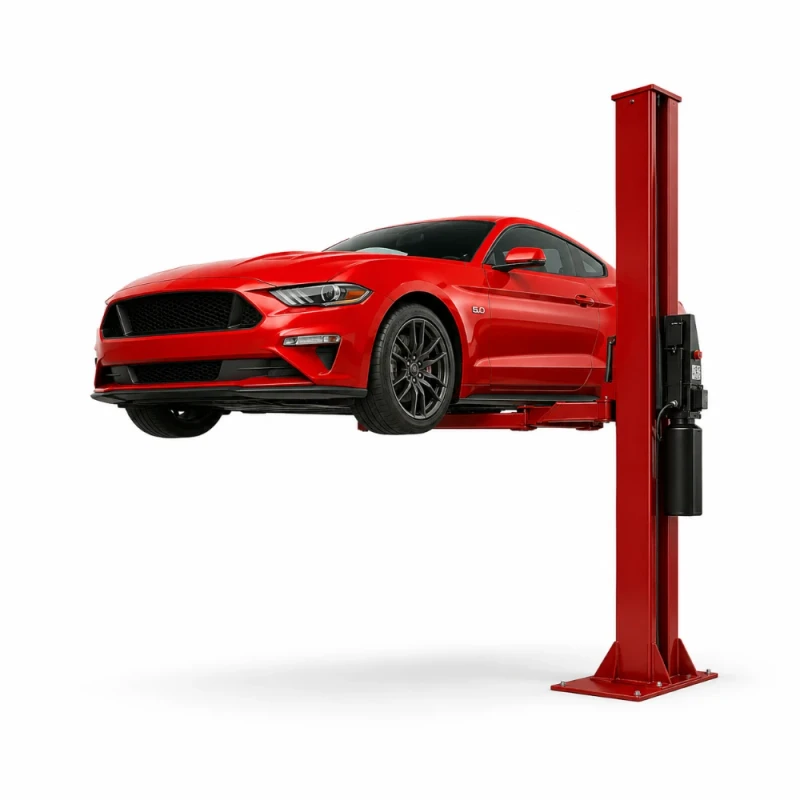
Two vertical columns bolted to a reinforced concrete slab carry carriage arms that swing under the vehicle and lift it from the pinch welds or frame lifting points. The vehicle hangs between the columns, leaving the entire undercarriage – engine, transmission, exhaust, suspension, and fuel tank – open and reachable from a rolling stool. Most 2-post lifts are symmetric, with arms that extend equally on both sides for balanced loading, or asymmetric, with longer arms toward the rear for better door clearance when you open a car between the posts. They run on a 220V hydraulic power unit that raises a typical car to working height in 30-45 seconds, and the columns anchor into the slab with heavy-duty expansion anchors torqued to the manufacturer's spec – which is exactly why concrete quality matters so much for this design. A direct-drive screw or chain-over-roller system transfers the lift from the power unit to each carriage, and a mechanical ladder of safety locks holds the vehicle at any height without relying on hydraulic pressure alone, so a sudden hose failure never drops the car. The arms swing in and out of the way when not in use, so a 2-post bay can still be parked in when the lift is idle – though you can't stack a second vehicle underneath a raised 2-post the way you can with a 4-post.
Best Use Cases
Oil changes, brake jobs, suspension and exhaust work, transmission removal, and any task where you need to reach the underside of the vehicle from front to back. Professional shops and serious home enthusiasts lean 2-post because nothing else gives you this much unobstructed access to the chassis. If you spend your weekends replacing control arms, dropping transmissions, or chasing exhaust leaks, a 2-post is the tool that makes that work fast, safe, and far less miserable than jack stands. It's also the right choice when you service a variety of vehicles – cars, trucks, and SUVs – because the adjustable arms adapt to nearly any wheelbase and lifting point.
Pros
- ✓ Full undercarriage access – nothing blocks the engine, trans, or exhaust
- ✓ Lower cost ($2,500-$7,000) than a comparable 4-post
- ✓ Smaller footprint (12' × 12') fits tighter garages
- ✓ Faster lift/lower cycle (30-45 seconds)
- ✓ free shipping from AutoHoistPro
Cons
- ✗ Requires a 4-inch reinforced concrete slab for anchoring
- ✗ Cannot drive another vehicle underneath when raised
- ✗ More involved installation (anchoring, leveling, hydraulic plumbing)
What Is a 4-Post Lift?
How It Works
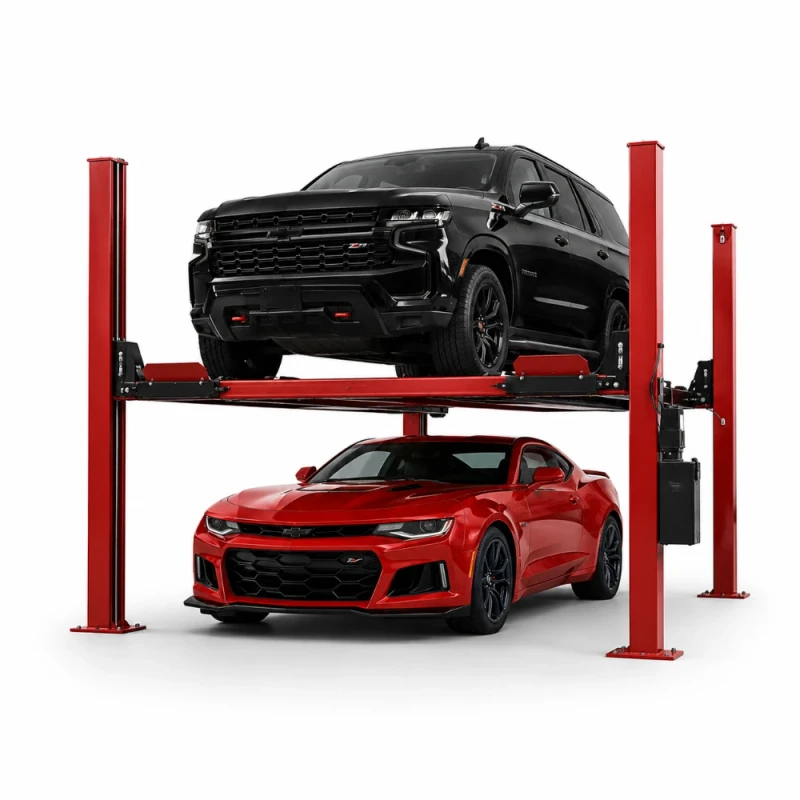
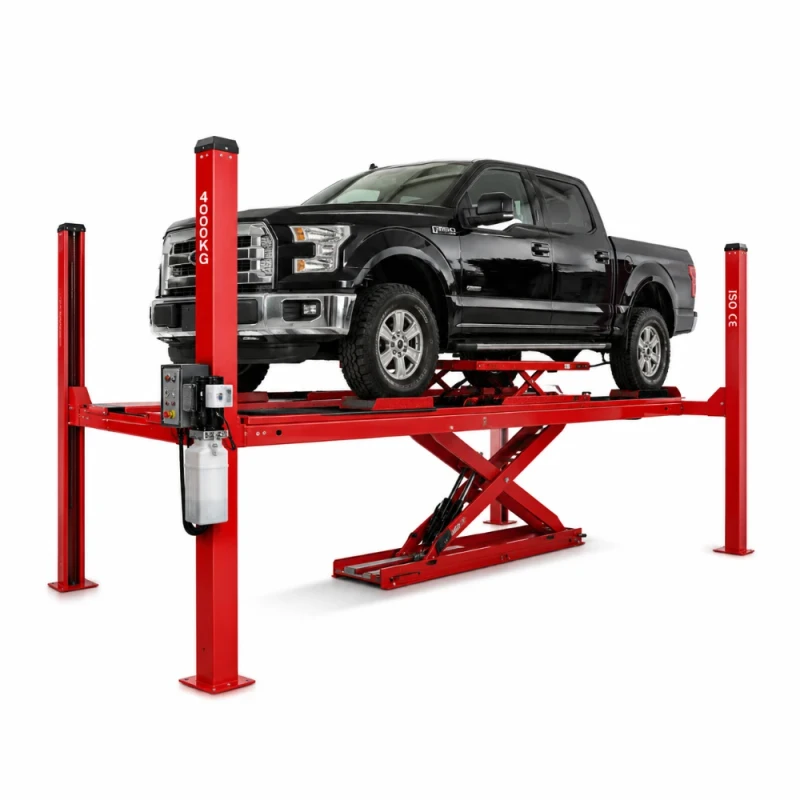
Four posts support two long runways that you drive the vehicle onto, wheels and all. The hydraulic system lifts the entire runway platform – vehicle included – straight up, so the car stays parked on its tires at full height. Because the load rests on the runways rather than hanging from arms, no concrete anchoring is required for most home use, which makes a 4-post effectively portable: with casters installed you can roll and reposition it, or unbolt it and take it with you when you move. Most 4-posts use a 220V power unit driving cables or a hydraulic cylinder, and the runways include built-in wheel stops and a locking ladder so the platform stays mechanically locked at the height you choose. The runways are spaced wide enough for most vehicles to drive on comfortably, but that spacing is also why a 4-post claims a larger footprint than a 2-post even when it's lowered – the steel is always there, occupying the bay.
Best Use Cases
Vehicle storage is the killer feature – you park a second car underneath the raised platform and effectively double your garage's capacity, which is why collectors and tight-garage owners love them. Four-posts also shine for quick maintenance that doesn't need full undercarriage access: oil changes and tire rotations you can do right on the runways, and they're a favorite for show-car display where you want a vehicle elevated and visible without ever putting it on stands. Add a rolling bridge jack (about $400-$800) and you can lift the vehicle off the runways for brake and suspension work, narrowing the access gap with a 2-post at the cost of an accessory and a slower workflow.
Pros
- ✓ Store a second vehicle underneath (double parking)
- ✓ No anchoring required – portable
- ✓ Easier installation (roll into place, connect power)
- ✓ Safer for long-term storage (vehicle rests on its wheels)
- ✓ free shipping from AutoHoistPro
Cons
- ✗ Limited undercarriage access (runways block the center)
- ✗ Higher cost ($3,000-$8,000)
- ✗ Larger footprint (14' × 16')
- ✗ Slower operation than a 2-post
Head-to-Head Comparison
Cost
A 2-post runs $2,500-$7,000 with an average around $3,800; a 4-post runs $3,000-$8,000 with an average around $4,500. Both include free shipping from AutoHoistPro, which saves $300-$800 versus freight-charging dealers. For the same lifting capacity a 2-post is almost always less expensive because it uses two columns and two arms instead of four posts and two full runways – less steel, simpler hydraulics, and a smaller power unit. The gap widens at the top end, where commercial 4-posts with long runways climb toward $8,000 while heavy-duty 2-posts top out around $7,000. Factor in accessories and the comparison shifts a little: a 4-post often needs a bridge jack to match a 2-post's repair access, adding $400-$800, while a 2-post may need truck adapters for lifted vehicles, adding $100-$200. Even so, the 2-post lands cheaper for the same usable capability in most home-garage builds.
Space Requirements
A 2-post needs a 12' × 12' footprint and an 11'-12' ceiling; a 4-post needs 14' × 16' and 12'-14'. If your garage is tight, the 2-post wins – its posts sit at the sides and the bay between them stays open, whereas a 4-post's runways claim the full footprint even when lowered. Add 36" of clearance on each side for arm swing and door opening, and a 2-post fits in most standard 2-car bays while a 4-post really wants an oversized or 3-car layout. Ceiling height is the other constraint: a 4-post storing a tall SUV overhead needs 13-14 feet, which rules out many standard residential garages, while a 2-post lifting the same SUV for repair work can often get by on 12 feet.
Installation Difficulty
A 2-post is a moderate install: drill anchor holes, set and torque anchors, plumb the columns, run the hydraulic lines, and connect 220V – plan 4-8 hours with a helper. A 4-post is genuinely easy: roll it into place, bolt the runways to the posts, connect power, and you're lifting in 2-4 hours. The 4-post wins for DIY, especially in a rented space where you can't (or don't want to) drill 16 anchor holes into someone else's slab. If your concrete is marginal, the 4-post's no-anchor design is also a safety net – it spreads the load across a larger footprint instead of concentrating it at four anchor points.
Versatility
This is the real fork in the road. A 2-post is built for repairs and maintenance – maximum access, every time. A 4-post is built for storage and display – convenience and capacity, with limited access. You can add a rolling bridge jack to a 4-post to lift the vehicle off the runways for wheel or brake work, but it's an extra $400-$800 and still slower than a 2-post. Conversely, you can't easily add storage to a 2-post – you can't park under a raised vehicle hanging from arms. The winner depends entirely on what you do with your cars, and no accessory fully converts one design into the other.
Capacity & Weight Ratings
Both designs span a similar capacity range, but they carry weight differently. A 2-post concentrates the entire vehicle's weight on four lifting points at the arms, so the arms, carriages, and columns all have to be sized for the full load – and an overloaded 2-post is more obviously dangerous because the vehicle hangs in the air. A 4-post spreads the same weight across four posts and two long runways, so the load per point is lower, which is part of why 4-posts feel rock-solid for long-term storage. For home garages, a 10,000 lb rating covers roughly 95% of passenger vehicles including full-size pickups; step up to 12,000 lb if you work on heavy diesels or lifted trucks, and to 14,000-18,000 lb only for commercial use or true heavy-duty trucks. Buy a lift rated at least 25% above the heaviest vehicle you'll put on it – that margin keeps the hydraulics, locks, and steel well within their comfort zone and extends the lift's life. Overrating costs a little more up front but eliminates the "is this too heavy?" anxiety every time you load a new vehicle.
Which Should You Choose?
Choose a 2-Post Lift If:
- You do your own repairs and maintenance
- You have limited garage space
- Budget is your primary concern
- You need full undercarriage access
- You have adequate concrete (4+ inches, 3,000+ PSI)
A 2-post rewards the hands-on owner who wants every bolt reachable. The trade-off is the install: anchoring and a 220V circuit are non-negotiable, so your slab and your panel have to be ready. If you're the person who drops transmissions, replaces exhausts, and does your own brakes, the access is worth every anchor hole.
Choose a 4-Post Lift If:
- You need vehicle storage (double parking)
- You can't anchor to the floor (rented space, slab too thin)
- You want easier installation
- You display show cars
- You have room for the larger footprint
A 4-post rewards the collector and the renter. No anchors, no permanent commitment, and a second parking spot for free – at the cost of access and floor space. If you've outgrown your garage's parking before you've outgrown its wrench-turning, the 4-post solves your actual problem.
Still can't decide? A simple test: if you're under the car more than once a month, get a 2-post – the access pays for itself in time saved on every job. If you're under the car a few times a year but need your garage to hold more cars, get a 4-post – the storage pays for itself in driveway space saved. And if you do both equally, buy the 2-post first; you can always add a 4-post later for storage, but a 4-post can never give you back a 2-post's access.
Real Customer Scenarios (2026)
Numbers beat opinions. Here are three 2026 buyers and how they chose:
-
Home mechanic, California – 2-post lift. Paid $3,400 with free shipping, installed it himself in a 20' × 20' garage with a 12' ceiling. He chose 2-post because he does his own brake and suspension work and wanted full access; the 12' × 12' footprint left the rest of the bay for a workbench and tool chest. He added truck adapters for his F-150 and has never wished for a 4-post.
-
Car collector, Texas – 4-post lift. Paid $4,800 with free freight, rolled it into a 30' × 24' shop with a 14' ceiling. He stores three cars vertically and never touches the undercarriage, so the runways blocking access didn't matter – storage was the whole point, and no anchoring meant no drilling into a brand-new epoxy floor. He can reposition the lift if he reorganizes the shop.
-
Small shop, Florida – 2-post lift. Paid $4,200 with free freight for a 12,000 lb unit, anchored to a 5-inch slab with a dedicated 220V circuit. Professional repairs demand maximum access, so 2-post was the only real choice; the heavier capacity handles the shop's trucks and vans without straining, and the faster cycle time matters when six cars wait in line.
Frequently Asked Questions
Can I use a 4-post lift for repairs?
Yes, but access is limited. The runways block the center of the undercarriage, so for major work you'll need a rolling bridge jack or a set of jack stands to raise the vehicle off the runways – an extra step and an extra $400-$800 in accessories. For routine oil changes and tire rotations the runways are fine, and you can do those without ever lifting the car off its wheels.
Do both types require 220V power?
Yes, both run on a 220V/240V single-phase outlet (30-50 amp). Adding one costs $200-$500 if you don't already have it. Some 2-post models offer a 110V power unit, but 220V cycles faster, runs cooler, and lasts longer under daily use – and on a 4-post, 220V is effectively standard.
Which is safer?
Both are equally safe when ALI-certified and properly installed. AutoHoistPro only sells ALI-certified lifts, so whichever you choose, it has been independently tested to the ANSI/ALI ALCTV safety standard for structural integrity, lowering speed, and lock engagement. The unsafe lifts are the non-certified gray-market imports – not the certified 2- or 4-post from a reputable dealer.
How long does shipping take?
2-5 business days, free freight from our 3 US distribution centers in Bakersfield CA, Wenatchee WA, and Fargo ND. West Coast addresses usually ship in 1-3 days from Bakersfield; central states in 2-4 days from Fargo. See our distribution centers page for transit times to your state.
Conclusion
The short version: choose a 2-post for repairs and access, a 4-post for storage and ease. A 2-post gives you the whole undercarriage for less money and less space, at the cost of anchoring and installation effort. A 4-post gives you double parking and a portable, no-anchor setup, at the cost of access and a bigger footprint. Whichever you pick, both ship free freight from AutoHoistPro's 3 US hubs, saving you the $300-$800 most dealers add for LTL freight. Ready to decide? Browse 2-post lifts and 4-post lifts – every model is ALI-certified and includes free shipping, so the price you see is the price you pay.